
Back-to-school checklist: everything we forget until the last day
The 2026-2027 school year starts on Monday 24 August 2026 in the Fédération Wallonie-Bruxelles. Here is what is left to do, in order.
At D-30: confirm enrolment, book after-school care and meals, make medical appointments, check vaccinations. At D-15: take stock of last year's supplies before buying, try on clothes and shoes, label what needs labelling. At D-7: set the drop-off and pick-up schedule, lock in activities, plan the first week's meals. The night before: pack the bag, lay out the clothes, put the first-day paperwork where you will see it.
Each block is detailed below. You can also download the full checklist as a PDF and print it.
Running late? Start from the bottom
This list works in four stages. If you find it two weeks before term starts, do not go back to the beginning. Take the D-15 block, then the D-7 block. The two that genuinely matter are admin and medical, because they depend on other people, and other people have waiting times.
D-30: the admin
This is the least rewarding block, and the one that goes wrong latest. Every line depends on someone else: a school, a municipal service, an after-school provider. The earlier you start, the less their delays become your problem.
Confirm enrolment and the documents the school has asked for
Ask the school, in writing, what it provides this year (this is where most double-buying happens)
Book after-school care, extracurricular care, hot meals
Check the real timings: drop-off, pick-up, Wednesday
Update the list of people authorised to collect your child
The highest-return line here is the second one. A written question to the school about supplies often saves a third of the equipment budget, and a second shopping trip during the first week of term.
D-30: the medical
Same D-30, different reason: diaries. In August, practices are partly closed and slots go fast.
Book the appointments: dentist, optician, paediatrician
Check vaccination boosters and the health record
Renew any prescriptions expiring this summer
Check what your health fund reimburses for sport
Book the appointments back to back rather than spread over weeks. One call, several slots, and the subject is closed until January.
D-15: the supplies
Take stock of last year before buying anything
Try on clothes and shoes, write down the real sizes
Label what needs labelling
Sort out the sports kit and the swimming bag
Buy only what the school does not provide
Inventory first, purchase second. It is the order that saves money, not the list.
D-7: the logistics
The block nobody writes down, and the one that weighs most once the year is running.
Set the standard week: who drops off, who collects, which day
Lock in activities and Wednesday afternoon
Check transport timings (bus, season ticket, route)
Plan the first week's meals
Agree with the other parent on who carries what
That last line is not a formality. A schedule that lives in one person's head is not a schedule, it is a load. Write it somewhere the other parent can read without having to ask you.
The night before
Pack the bag, lay out the clothes
Put out the papers to sign for the first day
Set the alarm, plan the wake-up
Remember that nothing will be perfect
Worth knowing: the school premium is automatic
The annual age supplement, usually called the school premium, is paid automatically in early August, together with the July family allowance. Nothing to apply for.
2026 amounts in Brussels and Wallonia, based on the child's age on 31 December of the previous year:
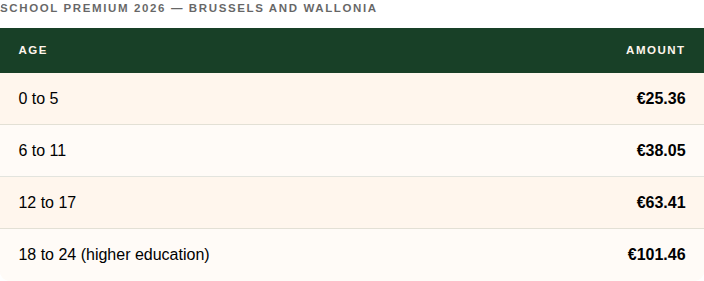
Source: Iriscare, press release of 29 July 2026. Flemish amounts (schoolbonus) differ.
What the checklist does not cover
A checklist answers one question, and only one: what to do.
It does not answer the second one, the one that takes up the most room. Remembering it needs doing. Checking that it got done. Knowing that if nobody checks, it will be you.
That is why a good list helps on day one and not for the month that follows. The visible work, buying, booking, filling in forms, is a small share of the total. The rest is follow-up, and follow-up has no tick box.
This is not a method problem. It is not a personal organisation problem either. Family coordination is real work, and it rarely splits evenly between two people.
Keep the list, put down the load
Print the checklist, tick what you can, hand over what can be handed over. And if this year you would rather not carry it alone, tell us.
Less mental load. More to live.
